Why ADHD Hacks Stop Working (and what you should do instead)
If you've ever found a productivity hack that felt life changing... and then felt helpless as it slowly fell apart over a couple weeks, you aren't alone. More importantly, you're not lazy, undisciplined, or broken. There are a few reasons this keeps happening, and once you understand it, you can start letting go of the shame and start experimenting with strategies that work better for you.
Let's talk about why ADHD hacks stop working, and what you can do instead.
The Real Reason ADHD Hacks Stop Working
Let me introduce you to the concept of INCUP (btw I wrote a whole post on how you can use it if you want to learn more!) INCUP is a framework that describes five factors that can make tasks more motivating for people with ADHD. It stands for:
I — Interest
N — Novelty
C — Challenge
U — Urgency
P — Passion
Btw, I wrote a whole article on INCUP and how you can use it in your life if you want to learn more! → my full guide to using the INCUP framework.
When you find a new hack and it works, it's usually because of novelty. It feels exciting, fresh, and full of possibility. You convince yourself that this is finally going to be the one. But novelty, by definition, always wears off.
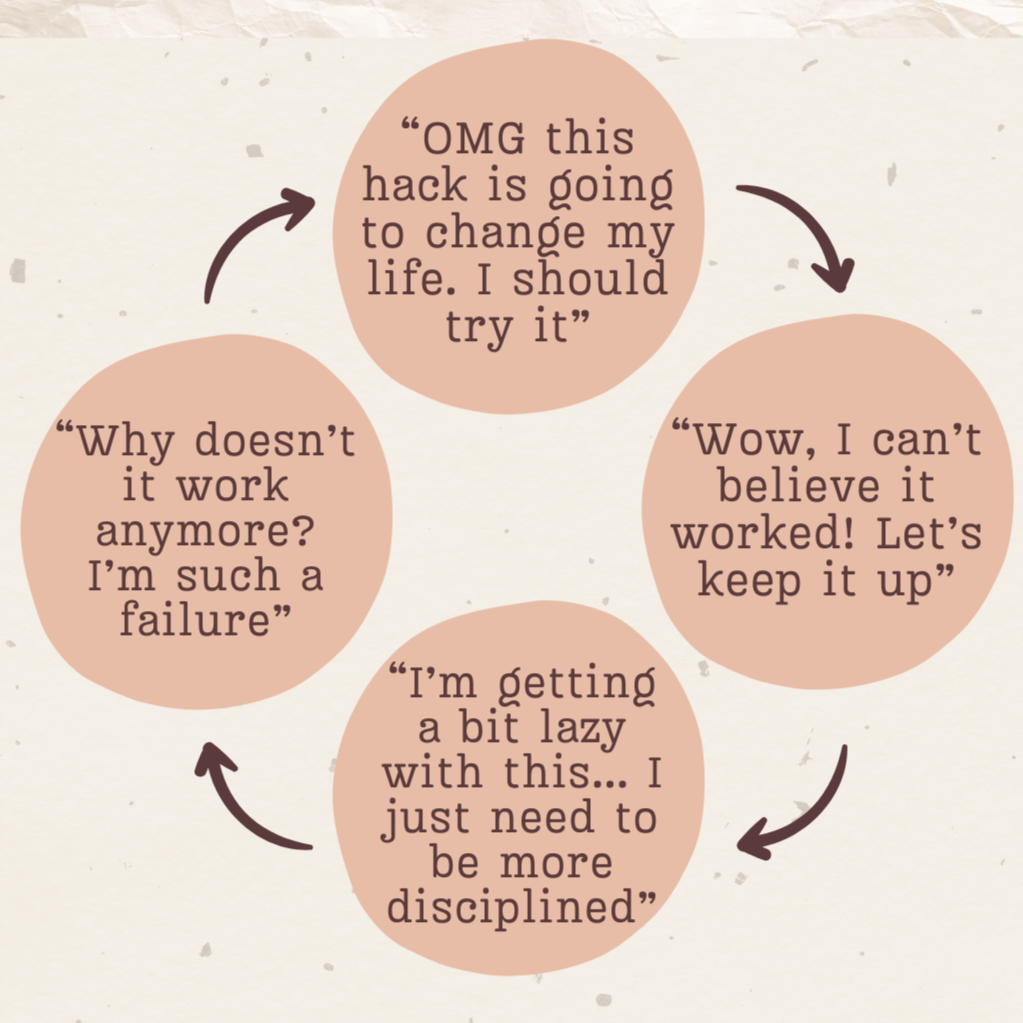
The Novelty-Seeking Cycle
Here's what the pattern typically looks like:
Stage 1: "Oh my gosh, this hack is going to change my life. I have to try it." You found something that looks promising and you want to give it a try. You're motivated, consistent, and genuinely excited.
Stage 2: "Wow, it's actually working! Let's keep this going." You're still riding that novelty wave, and you're feeling hopeful that it's actually going to stick this time.
Stage 3: "I'm getting a bit lazy with this... I just need to be more disciplined." This is often where a strategy that was once helpful starts requiring more effort to maintain. The novelty is wearing off. You're starting to blame yourself. You’re shifting to relying on willpower, which only lasts so long.
Stage 4: "Why doesn't it work anymore? I'm such a failure." You're waving the white flag and feeling ashamed that yet another thing hasn't worked out. Soon, the cycle starts again with the next new thing.
Why It Feels Like Your Fault (But Isn't)
When a hack that once worked suddenly stops working, it’s easy to assume the problem is you. I just need to try harder. I need more discipline. I need to stop being so lazy. It makes sense that this is what you've defaulted to, because it's often what we've been taught.
The answer isn’t necessarily more willpower. You may need a different strategy, a new approach, or something better suited to what you need right now.
Your ADHD Hack Stopped Working. What Next?
1. Keep Things Feeling Fresh
If novelty is what made a hack work in the first place, you can be intentional about reintroducing it. This means having a few variations and building rotation into the system.
When a strategy starts feeling stale or harder to maintain, experiment with changing one element rather than abandoning the entire system.
You can also look for ways to “resparkalize” something without completely changing it up. This is often changing something small while keeping the core the same.
2. Lean Into the Other INCUP Motivators
Novelty is only one of five motivators. When novelty fades, you can pivot to another source of fuel.
Interest: Connect the task to something you genuinely care about. How can you get curious? Is this connected to a larger goal?
Challenge: Gamify it. Race against a timer or someone else. Try and beat your personal best. Can you turn it into a minigame?
Urgency: Create a small deadline or add external accountability. Body doubling can also provide enough external structure to make starting feel easier.
Passion: Find the why behind the task. When a task connects to your values or a bigger vision, it can feel more meaningful and easier to engage with.
3. Build Personalized Systems.
Hacks are borrowed strategies. Systems are built for you.
This is the core difference between short-term fixes and long-term change. A personalized system takes into account your specific motivators, challenges, routines, environment and goals. And it doesn’t have to work perfectly every day. A good system is one that is flexible enough to adapt when your energy, schedule or motivation changes.
This is exactly what ADHD coaching can help with. Rather than handing you another list of things to try, coaching gives you space to figure out what is getting in the way and build strategies around your actual life, challenges, and goals.
The goal isn’t to find that one perfect hack. It’s to build a life where you don’t feel the need hacks anymore.
What if a Strategy Stops Working Again?
When a strategy stops working, that doesn’t mean it was ever a bad strategy.
Your circumstances, workload, and energy changes. What got you feeling motivated a week ago might not motivate you today.
Instead of asking “why can’t I stick to this?” Try “what changed, and what do I need now?”
Now you know how to adapt and pivot your strategies instead of starting over again at ground zero looking for a new shiny hack.
Stop Searching for the Perfect ADHD Hack
If you've tried productivity systems, planners, routines, apps, and hacks that worked for a while but eventually fell apart, you don't necessarily need another strategy. You may need help figuring out why your current strategies aren't working and what needs to change.
ADHD coaching can help you build personalized systems for things like task initiation, motivation, organization, follow-through, and managing your workload.
Book a free 20 minute discovery call to talk about what's been getting in your way and see whether coaching could be a good fit for you.
Last Updated: August 2026