Are You Using the Wrong Fuel for Your ADHD Brain? (Introducing the Solve-It Grid)
If I had to guess, you’re the type of person who can write an entire essay the night before it’s due, while your laundry piles up for months on end. No judgement here, I know what it feels like to look at that finished paper while wearing my last clean outfit thinking “why could I do this and not the dang laundry?”
For years, I thought I was just lazy or lacked willpower. Once I learned I had ADHD it all began to make sense. I was dealing with executive dysfunction, and trying to motivate myself in ways that just weren’t working for me.
Understanding what influences your motivation can help you break out of the cycle of procrastination, burnout and guilt. To help visualize this, I love using Tamara Rosier’s Solve-It Grid.
What is the Solve-It Grid?
The Solve-It grid is a tool developed by Dr. Tamara Rosier, author of Your Brain’s Not Broken. It helps us categorize tasks by asking two questions:
Is it fun?
Is it stimulating?
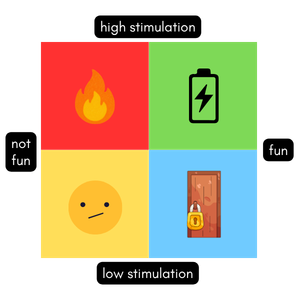
This creates four quadrants that can help us think about why some tasks feel easier to approach than others.
Breaking Down the Four Quadrants
1. The Red Zone (Fires)
This is where you would put anything you’re panicked over, last minute tasks, or emergencies. It’s where all the results of our procrastination would go. As we know, urgency can be a powerful motivator for many people with ADHD. We think this is the fuel our brains need, because it is effective in getting us to start and finish something. The issue here is that always putting out fires gets exhausting pretty quickly, and leads us sliding into the blue zone.
2. The Yellow Zone (Meh)
Think of all the boring tasks that are endlessly piling up on your to-do list. Laundry, going through your emails, sorting papers… yawn. These tasks may not provide enough immediate interest, stimulation or urgency to make them easy to start. Without anything motivating us to attend to these tasks, they end up rotting until they turn into a big ole’ fire. Then, we can finally attend to it.
3. The Blue Zone (Locked Door)
Once you’ve been completely burnt out by fighting all your red zone tasks, and/or you’re overwhelmed by everything that has piled up in the yellow zone, your brain is looking or some low effort comfort. That’s where it finds the blue zone AKA the locked door. It’s called the locked door quadrant because once you get into it, it’s very hard to get out. This would be things like doom scrolling on social media or watching random youtube videos. It provides you with a bit of feel good entertainment that doesn’t take a lot of effort to start (which is the hardest part, after all). It can feel restorative in the moment, but it may not be the kind of rest that actually leaves you feeling replenished.
4. The Green Zone (Recharge)
This is where we truly want to be! Engaging with our favourite hobbies, creative projects, moving around, playing or learning about our latest hyperfixation. This is the brain fuel we want to be relying on. A common misconception is that these things should be the reward for after you finish your work. But fun is fuel. These types of activities can give you the energy or stimulation that may make it easier to approach less engaging tasks afterward.
The ADHD Cycle You’re Tired of Explained
If you’re struggling with ADHD and executive function, I think I have an idea of what your average day looks like.
You stare at your long to-do list that’s filled with boring things you’d really rather not do.
Unable to start anything and feeling overwhelmed, you find yourself doom scrolling on your phone without realizing that you even started.
The boring tasks go ignored for hours until midday hits and you realize you haven’t got anything done. Now they’ve exploded into red zone fires.
You exhaust yourself putting out all those fires, collapse and go back into some numbing blue zone activity, meaning you never get around to something in the green zone that might actually help you recharge.
A Better Brain Fueling Strategy
Start your day in the green. Before you sit down to study or head to class, start with a short activity that would be in the green zone. A few examples include 15 minutes of sketching or dancing to your favourite song. Give yourself some interest, movement, or enjoyment before diving into the more boring parts of your day. It can help make things feel easier later!
Pair some fun with your yellow zone activities. I promise it’s not cheating. You’re allowed to listen to music, put on a podcast or set up a body doubling session with a friend if it makes it feel easier. You don’t have to earn your enjoyment by finishing all your work first.
Know what your blue zone doors are. Just being more aware of what they are is the first step in helping ourselves avoid them. We can then add friction to getting to it, while reducing friction around what we should be doing. For example, using focus mode on your phone (adding friction) and leaving your textbook on your desk for easy access (decreasing friction).
The Goal Isn’t to Live in the Green Zone
It isn’t about making everything fun and avoiding anything that’s boring. While it would be great if everything we had to do was fun, some parts of school and life are just going to be boring.
The goal is to understand what makes certain difficult tasks easier to approach, and experiment with what works for you.
Sometimes that means adding stimulation, creating urgency or shrinking down the task. Sometimes you genuinely just need to rest and recharge.
It’s Time to Take Control
Understanding your patterns is just the first step. Learning how to create sustainable systems built around how you work is where things can finally start to feel manageable.
At New Bloom ADHD Coaching, we specialize in helping young adults and post-secondary students with ADHD stop relying on the panic-fueled motivation of procrastination. In coaching we’ll work together to figure out what’s been getting your way, and move forward with concrete strategies around motivation, task initiation, procrastination and more.
Ready to Stop Relying on Panic to Get Things Done?
ADHD, AuDHD or executive function coaching can help you understand your cycle of procrastination and figure out a new strategy that doesn’t depend on a looming deadline as your only option.
Book a free 20 minute discovery call, which is really just a laid back chat to figure out if working together is the right fit for what you need.
Last Updated: September 2026